Prior to 1947, hundreds of Princely States existed in India which were not formally ruled by the British, but rather by a local or regional ruler. These vassal states, also called native states, were subject to a subsidiary alliance and the suzerainty or paramountcy of the British Crown. Along with status, size and wealth differences, Princely State coins varied vastly as well. However, not all Princely States issued their own coins. Check out the ones that did:
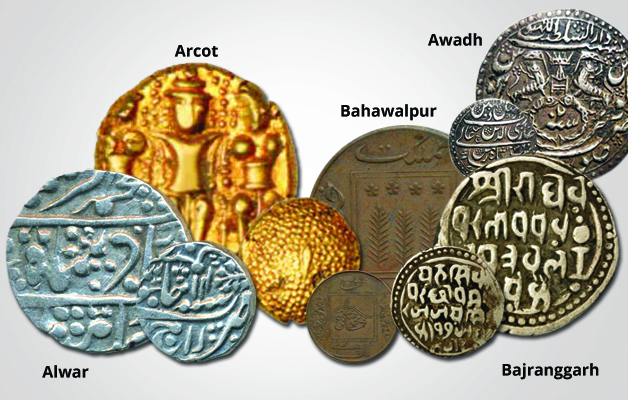
Coins of Alwar: The first mint of Alwar was situated at Rajgarh where these Indian Princely state coins were struck from 1772 to 1877 and thereafter at Calcutta. Shedan Singh and his succeeding rulers struck coins in their own name as well as the name of the Queen. However, Pratap Singh and Bakhtawar’s coins bore the name of Shah Alam while Bani Singh’s coins portrayed the name of Muhammad Bahadur
Coins of Arcot: The earliest coins were struck in the name of Mughal Emperors. After their fall, the Nawabs started issuing coins in their own name. Most of the coins bear inscriptions in Persian but some come in Tamil as well. Motifs and symbols present on coins include – flower, horse, elephant, fish and geometric designs. Interestingly, they also inscribed many Hindu deities.
Coins of Awadh: The first coins were struck in 1737 at Muhammadabad Banaras mint in the name of Mughal Emperors. The British seized Banaras after the Battle of Buxar and the mint was moved to Lucknow in 1776. Coins were also issued from Bareilly having the Muhammadabad Banaras mint name with that of Mughal rulers. In 1819, Nawab Ghaziuddin Haider started to strike coins on his name. He introduced his coat of arms and placed his own legends in the form of couplets. During the war of Independence in 1857, the revolutionaries did not accept the influence of English and so they issued gold, silver, and copper Princely state coins in the name of Shah Alam II, with the mint name ‘Suba Awadh’ in 1229 A.H.
Coins of Bahawalpur: Prior to 1886, the Bahawalpur State issued two kinds of rupee- the Bhawalpuri rupees worth 12 annas and Ahmadpuri rupees worth 10 annas in British currency. Copper nika paisa (or small pice) and two and half of British copper anna were also issued. The mint names at the bottom of the reverse of Bhawalpur State are often off the flans. In most cases, these rupees could be attributed to one of the three mints i.e. – Ahmadpur, Dar-al-Islam, and Khanpur.
Coins of Bajranggarh: The mint epithet of Bajranggarh was Jainagar. All the coins, irrespective of when they were minted, bore similar obverse legends in Devanagiri script: Yah Sikka Par Chhap Sri Jai Singh/ Sri Aakbra Badshah ki hai, Janag (for Jainagar). The reverse had ‘Sri Raghav Paratap Pavan Putra Bal Payake’ inscription.
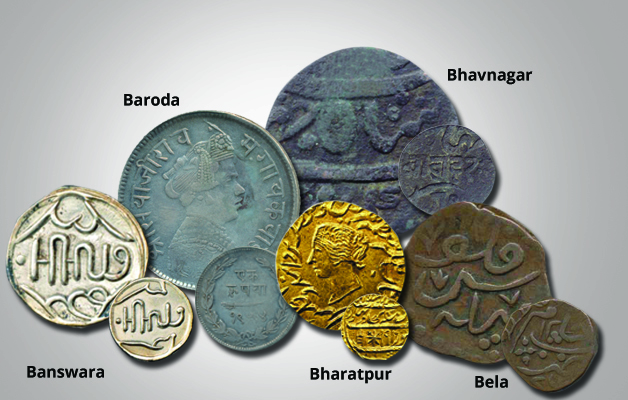
Coins of Banswara: During most of the 19th century, Banswara used the ‘Salim Shahi’ coinage of the neighboring Pratapgarh State. But in around 1870, Maharwal Lakshman Singh defied a British prohibiting order of that year and introduced a series of crude coins in copper, silver, and gold for use within the state. The legends on these princely state coins are in a secret script and are said to have been invented by Lakshman Singh himself. The central word in these legends has been tentatively identified as ‘Samsatraba’ (for “Samba Satra”, a designation for the Hindu deity Shiva) in the longer form or ‘Samba’ for the shorter form. All the gold and silver coins along with a few rare copper ones carry the longer form. The copper coins were made for circulation, but the gold and silver were produced mainly for presentation.
Coins of Baroda: The first coin of Baroda was issued by Manaji Rao Gaekwad following the Maratha style of imprinting name of Shah Alam II, only change was that they added an initial letter of the issuer. Coins of Damaji Rao Gaekwad featured scimitar as he had received the title of ‘Shamsher Bahadur’ or distinguished swordsman. After 1857, these princely state coins were issued in the name of ‘Commander of the Sovereign Band’ in Persian script. After the 1870s, devnagari legends were inscribed but eventually, the bust of Ruler was featured.
Coins of Bela: The only local coins, whichever appear to have circulated in the Las Bela state consisted of dukar and adhelo, struck at Bela in about 1855-56 in the reign of Jam Mir Khan II. The obverse bears the words ‘zarb Jam’ with the date and the reverse features the legend ‘flus-i-Bela’.
Coins of Bharatpur: According to Webb, Bharatpur in its early days had two mints which began in 1763 viz., Deeg and Bharatpur. Coins were struck at Maha Indrapur and Braj Indrapur too. The Deeg mint closed in 1878 and Bharatpur in 1883. The old local currency was called ‘hali’, which used to be almost similar in value to the British which were around ten British annas.
Coins of Bhavnagar: Anonymous copper coins bearing the distinguishing Nagari legend ‘Bahadur’ in addition to the Mughal legends are known.
Coins of Bhopal: Coins of Bhopal were minted at Raisen, Udaipur, Bari, Bhopal, Daulatgarh, Shujalpur and Rahatgarh. Rulers such as Muhammad Akbar II and Shah Jahan Begam issued Princely state coins in their own names. Anno Hijri calendar was followed by them to inscribe dates. Designs engraved included scimitar, wreath, trident, Persian legends, etc
Coins of Bijawar: The British currency was made legal tender in 1897. Prior to this, currency consisted of various local coinage including the Ratan Shahi rupee struck by Maharaja Ratan Singh.
Coins of Bikaner: Bikaner had formerly a silver and copper coinage of its own whose privilege was granted by the Mughal Emperors. They were minted in the name of Mughal Emperors. However, on 16th February 1893, the British offered to mint coins at no additional charge if they agreed to follow their designs. Hence an agreement was concluded in which 10 lakh of Bikaner rupees were made legal tender by being recoined at Bombay mint.
Coins of Brindravan: This town, the modern Vrindavan, was not a princely state. The neighboring city of Brindraban including the city of Mathura was under the Jat control in the mid-18th century, although nominally subject to Awadh. After varying fortunes, the area was passed to the East India Company in 1803-05. The coins of this region display symbols of Awadh, Mughals, Delhi and Bharatpur, although according to Krause Mishler, it is clear that they were not mints of any of those authorities, especially in the British period.
Coins of Broach: These were minted by Imtaya-ud-Daula under the British administration (East India Company). British currency system was followed. Coins of Nek Nam Khan were minted in the name of Shah Alam II and had a cross or flower mint mark on the reverse.

Were you aware that there were 565 officially recognized Indian Princely States in 1947? Out of these, more than 100 states minted their own coins at some point in history. Visit our history section for detailed information on the history of Indian Princely States. More on Princely State coins coming up very soon. Stay tuned.


The post Coins of Indian Princely States – Part I appeared first on Blog | Mintage World.
Comments
Post a Comment